Fairy Art Through the Ages
Fairy Art Through the Ages: Enchantment, Nature and the Unseen World
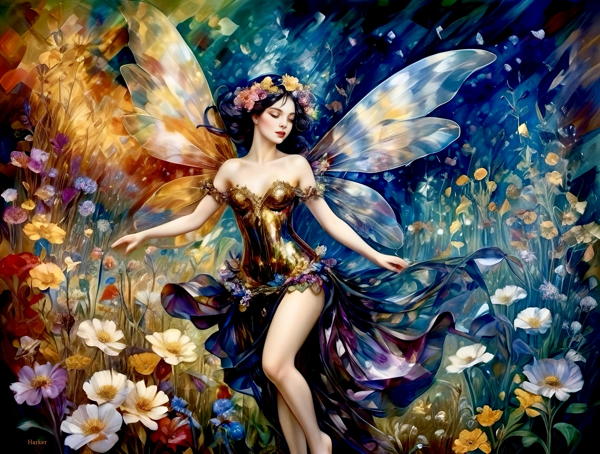
Fairy art invites us to look beyond the visible world. A flower becomes a doorway, a moonlit forest conceals a royal court, and an ordinary mushroom marks the edge of another kingdom. Whether fairies are portrayed as gentle guardians, mischievous spirits or dangerous supernatural beings, they allow artists to give shape to mystery.
Although fairy art is most strongly associated with nineteenth-century Britain, its roots reach much further back. The winged flower fairy familiar today did not exist in exactly the same form in ancient Greece or Rome. Classical artists instead portrayed nymphs, dryads, woodland spirits, river gods, satyrs, cupids and other beings who occupied the border between humanity, divinity and nature. Later artists blended this classical imagery with medieval folklore, Renaissance literature and local traditions to create the modern visual language of Fairyland.
The Classical Ancestors of Fairy Art
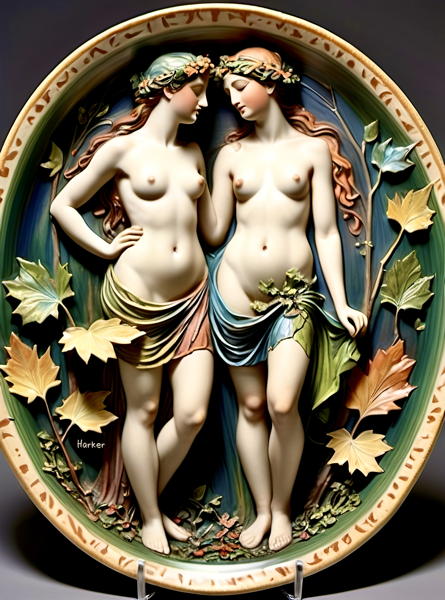
Greek Nymphs in Relief • Art by Harker
The Greeks and Romans did not use the modern English word “fairy,” but their mythology contained many comparable beings. Nymphs were female spirits associated with springs, rivers, trees, mountains and other parts of the natural landscape. Dryads belonged to trees and forests, while Naiads inhabited fresh water. These figures helped people imagine nature as alive, personal and spiritually significant. Getty educational material describes nymphs as beautiful nature spirits who attended goddesses, especially Artemis. [Getty][1]
In classical art, such beings appeared on pottery, mosaics, frescoes, reliefs and household decorations. An Archaic Greek vase attributed to Sophilos, dating from about 580–570 BCE, includes nymphs in the procession of gods attending the wedding of Peleus and Thetis.
These images served several purposes. They illustrated familiar myths, decorated sacred and domestic objects, and personified natural forces. A spring was no longer merely water flowing from the earth; it could be imagined as the dwelling place of a watchful spirit. A forest could possess its own personality, moods and dangers.
Classical nature spirits were not always sweet or harmless. They could enchant, seduce, punish or destroy those who violated sacred places. This mixture of beauty and danger would remain central to fairy art for centuries.
From Nature Spirits to the People of Fairyland
During the Middle Ages, European beliefs about elves, household spirits, hidden people, magical women and inhabitants of the Otherworld gradually mingled with classical and literary traditions. The English word associated with “fairy” was originally connected not simply with a tiny creature but with enchantment and a magical realm. The Oxford English Dictionary traces early uses from around 1330 to meanings such as magic and an enchanted land. [Oxford English Dictionary][2]
Medieval fairies were often closer to human size than the miniature, butterfly-winged figures found on modern greeting cards. They could be noble, frightening or morally unpredictable. Encounters with them frequently occurred at boundaries: twilight, crossroads, forest edges, ancient hills and the changing of the seasons.
In visual art, fairies therefore came to represent more than fantasy. They symbolized the uncertain territory between civilization and wilderness, reason and dream, safety and temptation.
Shakespeare and the Artistic Reinvention of Fairies
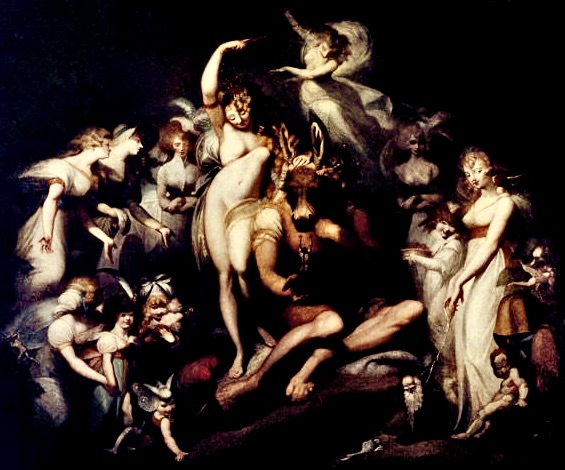
Fairy Titania and Bottom • Art by Henry Fuseli
William Shakespeare had an enormous influence on the appearance of fairies in Western art. In *A Midsummer Night’s Dream*, Oberon, Titania, Puck and their followers inhabit a moonlit woodland where identity, love and social order are temporarily overturned.
Shakespeare gave artists an ideal combination of theater, romance, comedy, beauty and supernatural mischief. During the centuries after the play was written, painters repeatedly depicted Titania’s enchanted love for the transformed Bottom, the quarrels of the fairy rulers and Puck’s magical interference in human affairs.
William Blake’s “Oberon, Titania and Puck with Fairies Dancing”, created around 1786, presents Fairyland as a visionary circle of movement and light. Henry Fuseli’s “Titania and Bottom,” painted around 1790, is stranger and more unsettling. Its distorted figures and dreamlike bodies emphasize the irrational power of desire. Tate identifies both works as important examples in the development of fairy painting. [Tate][3]
In these works, fairies are not merely decorative creatures. They expose human foolishness. Their magic reveals how easily affection can be manipulated, how unstable identity may be and how closely dreams resemble madness.
The Victorian Golden Age of Fairy Painting
Fairy painting became a recognized and particularly popular genre in Victorian Britain. ([Tate][3]) The Victorians lived during a period of rapid industrial growth, urbanization and scientific change, yet they were also deeply interested in ghosts, spiritualism, folklore and supernatural experience.
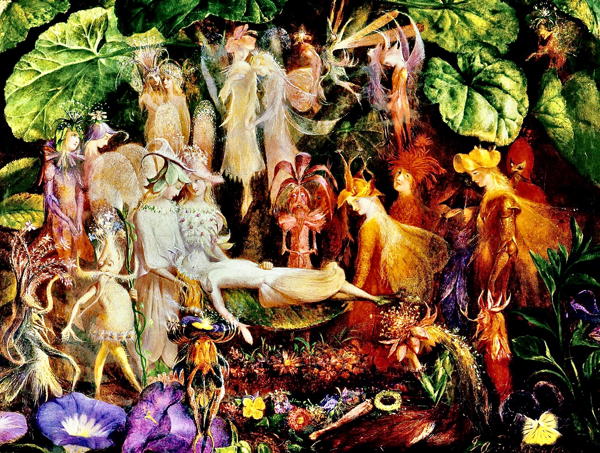
The Fairy’s Funeral by John Anster Fitzgerald
The British Museum notes that Victorian fairy literature and art flourished alongside the period’s economic and scientific materialism. Fairy imagery preserved a realm for imagination in what many people feared was becoming an excessively practical age. [British Museum][4]
Fairy paintings also allowed artists to explore subjects that might have been difficult to present directly. Beneath their elaborate wings and flowers, the pictures could contain suggestions of desire, danger, intoxication, social disorder and psychological anxiety. Because the scenes belonged to fantasy, they could cross certain moral and imaginative boundaries.
Among the leading artists of the genre were Richard Dadd and John Anster Fitzgerald. Fitzgerald became so closely associated with supernatural subjects that he was nicknamed “Fairy Fitzgerald.” ([Tate][5])
Richard Dadd’s *The Fairy Feller’s Master-Stroke*, painted between approximately 1855 and 1864, is one of the most extraordinary fairy pictures ever created. Tiny figures gather among grasses, flowers and seed heads while a central workman prepares to split a hazelnut for Queen Mab’s carriage. The picture’s crowded detail makes Fairyland appear not vague or insubstantial but intensely real—a complete society operating beneath ordinary human notice. [Tate][6]
Victorian fairy art was used in:
- Royal Academy paintings and private collections
- Illustrated books and literary annuals
- Theatrical scenery and costume design
- Decorative prints and household objects
- Children’s stories and educational publications
- Christmas cards and seasonal entertainment
A print based on Edwin Landseer’s celebrated painting of Titania and Bottom was admired after its 1851 Royal Academy exhibition. Queen Victoria reportedly described the original as beautiful, graceful and fairy-like. [National Gallery of Art][7]
Fairies and the Golden Age of Illustration
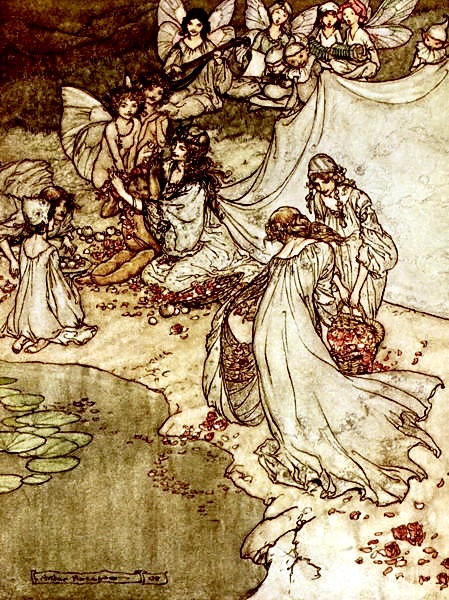
Fairy Iiustration from Midsummer Nights Dream by Arthur Rackham
Improvements in color printing helped fairy art move from galleries into books and family homes. By the late nineteenth and early twentieth centuries, illustrators such as Arthur Rackham, Edmund Dulac and Warwick Goble were creating richly detailed supernatural worlds.
Rackham’s 1908 illustrations for “A Midsummer Night’s Dream” combine elegant fairies with twisted roots, ancient trees and grotesque woodland creatures. His Fairyland is beautiful, but it is never completely safe. The development of improved color halftone printing allowed the subtle shades of watercolor illustration to be reproduced more effectively for a broad reading public. [Victoria and Albert Museum][8]
This period helped establish several familiar features of modern fairy imagery:
- Insect-like or transparent wings
- Clothing made from flowers, leaves and spiderwebs
- Fairies shown in miniature beside ordinary plants
- Mushroom circles, moonlight and enchanted forests
- A contrast between beautiful fairies and grotesque goblins
- Childhood as a time when the invisible world can still be perceived
Book illustration gradually softened many fairies. The dangerous beings of older folklore increasingly became protectors of flowers, companions of children or playful inhabitants of the garden.
What Fairy Art Means
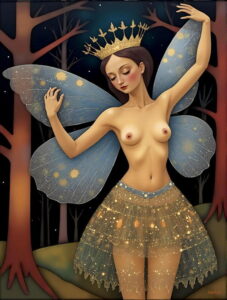
The meaning of fairy art changes according to the artist and the audience, but several themes continually return.
Nature given a face– Fairies personify the living energy of plants, water, weather and seasons. They make the natural world appear conscious rather than mechanical. A flower fairy suggests that even the smallest blossom possesses value and individuality.
Boundaries between worlds – Fairies inhabit thresholds. Their art is filled with doorways, circles, pools, caves, ruins and moonlit clearings. These locations represent moments when ordinary rules may temporarily disappear.
Imagination and creative freedom – Fairy art gives artists permission to abandon realism. Scale can change, plants can become architecture and human bodies can merge with insects, birds or flowers.
Beauty with an element of danger – Traditional fairies are not always kind. The most compelling fairy pictures preserve some uncertainty. Viewers may admire the enchanted world while sensing that entering it would carry a price.
Childhood and memory – Modern fairy imagery is often connected with childhood wonder. For adults, it can evoke nostalgia for a period when imagination and reality seemed less firmly separated.
Desire and transformation – Fairy magic changes appearances, emotions and identities. Consequently, fairy art frequently addresses longing, freedom, temptation and the wish to become something other than oneself.
Fairy Art in Modern and Contemporary Culture
Fairy art remains highly adaptable. It now appears in fantasy novels, children’s books, animation, video games, role-playing games, graphic novels, fashion photography, festival installations, tattoos and digital illustration. Contemporary illustration continues to move easily between traditional folklore and newly invented imaginary worlds. ([Victoria and Albert Museum][9])
Modern artists often use fairy imagery in several distinct ways.

Fantasy worldbuilding – Fairies can possess their own architecture, clothing, politics and ecosystems. Instead of serving merely as decorative figures, they become members of fully developed imaginary cultures.
Environmental symbolism: – A fairy guarding a damaged forest or surviving in an urban wasteland can represent ecological fragility. The smallness of the figure emphasizes how easily nature can be overlooked.
Personal identity – Wings, masks and transformed bodies can symbolize independence, gender fluidity, emotional change or the creation of an alternative self.
Dark fantasy and horror – Many contemporary artists have returned to the older idea of fairies as alien, predatory or morally unpredictable beings. This approach restores the tension that was sometimes removed from sentimental children’s art.
Digital enchantment – Animation, digital painting and interactive games can make fairy worlds move and respond. The viewer no longer simply observes the enchanted forest but can explore it.
Fairy art therefore survives not because people necessarily believe in literal winged beings, but because the image of the fairy remains useful. It expresses wonder, uncertainty, rebellion and our continuing desire to imagine that the world contains more than we can see.
The Enduring Doorway to Fairyland
Fairy art has never been only about tiny people with wings. At its best, it asks profound questions. Is nature alive? What hides beyond ordinary perception? How stable are our identities? What happens when imagination becomes more persuasive than reason?
From classical nymphs and Shakespearean spirits to Victorian fairy courts and digital fantasy worlds, artists have used supernatural beings to make the invisible visible. Fairy art keeps open a doorway that rational life is always trying to close—the possibility that a familiar landscape may contain another world, waiting just beyond the trees.
Magic FairiesThey always give you something, Wonder and wishes of childhood are And on occasions rare, if we are lucky, ©2026 Carl Scott Harker, publisher of
Gunslingers: Good, Bad and Fast |
Sources:
[1]: https://www.getty.edu/education/for_teachers/curricula/neoclassicism/downloads/Neocl_glossary.rtf” Académie Royale: French academy of fine arts established in …”
[2]: https://www.oed.com/discover/away-with-the-fairies/” ‘Fairy'”
[3]: https://www.tate.org.uk/art/art-terms/f/fairy-painting?utm_source=chatgpt.com “Fairy painting – Tate”
[4]: https://www.britishmuseum.org/collection/object/P_1886-0619-17/ “drawing | British Museum”
[5]: https://www.tate.org.uk/art/artists/john-anster-fitzgerald-185″ John Anster Fitzgerald 1819–1906″
[6]: https://www.tate.org.uk/art/artists/richard-dadd-130/richard-dadd-artist-and-asylum “Richard Dadd: The Artist and the Asylum”
[7]: https://www.nga.gov/stories/articles/william-shakespeares-plays-art “William Shakespeare’s Plays in Art | National Gallery of Art”
[8]: https://www.vam.ac.uk/blog/museum-life/wartime-fairy-tales “Wartime fairy tales • V&A Blog”
[9]: https://www.vam.ac.uk/blog/museum-life/va-illustration-awards-2020-shortlist-announcement “V&A Illustration Awards 2020 Shortlist Announcement • V&A Blog”
[10]: https://www.loc.gov/resource/gdcmassbookdig.fairytales00ande_0/ “Fairy tales … | Library of Congress”
Comments
Fairy Art Through the Ages — No Comments
HTML tags allowed in your comment: <a href="" title=""> <abbr title=""> <acronym title=""> <b> <blockquote cite=""> <cite> <code> <del datetime=""> <em> <i> <q cite=""> <s> <strike> <strong>