The Witch as a Mirror of Power: How Modern Art Turns Fear into Liberation
The Archetype We Tried to Bury
Once there were the wise women, a source of healing and creativity in tiny societies that dotted the world. Her presence became too much for religions that gathered social and political power to themselves. And thus the witch label was born and applied. For centuries thereafter, the figure of the witch symbolized danger — a woman too intelligent, too independent, or too intuitive for comfort. Society hunted her, silenced her, burned her.
But in modern art, she refuses to vanish. She reappears — not as a threat to be destroyed, but as a mirror to be studied. A mirror showing how every culture externalizes the power it fears most.
Today’s witch is not just a relic of myth. She’s a language of resistance. And modern artists are fluent in her dialect.
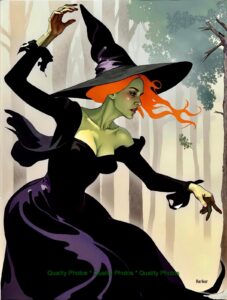
This witch image is available as an 8.5×11 inch photo print on eBay – Witch Defending Herself (click here)
Or find more witches here: More Witch Art.The Art World’s New Spell: Power, Control, and Reclamation
Across galleries and biennales (large-scale international contemporary art exhibition), the witch’s shadow flickers again — in installations, sculptures, and digital works. But her purpose has changed.
What once symbolized evil now exposes the systems that define it. By reclaiming witch imagery, artists are re-framing centuries of fear as the raw material of freedom. Each piece becomes a question: Who gets to define what’s dangerous?
The witch’s broom, the cauldron, the circle — all transformed into symbols of self-determined power. Art becomes alchemy: fear turning into fuel.
Why We Can’t Look Away
There’s a reason witch imagery grips audiences on a visceral level. Neuroscience reveals that images blending beauty and threat activate two opposing brain regions simultaneously:
The amygdala, triggering fear and attention.The ventral striatum, releasing dopamine, which drives fascination.
This paradox — attraction fused with apprehension — creates psychological stickiness. We are biologically drawn to what unsettles us.
Modern artists, knowingly or not, harness this neurochemical tension to make the witch unforgettable.
The Psychology of the Forbidden
The witch archetype is more than aesthetic. It’s emotional architecture. It encodes our collective discomfort with female autonomy, intuitive knowledge, and moral ambiguity.
When artists depict witches, they’re not illustrating folklore — they’re decoding repression. They turn taboo into texture. They show that fear of the “forbidden” often masks fascination with freedom.
Each artwork becomes a mirror for the psyche: Revealing how much of what we condemn in others is what we’ve denied in ourselves.
From Condemnation to Consciousness
Philosophically, the witch represents integration — the return of the exiled self. Modern art transforms her from scapegoat to sovereign. She no longer hides in forests; she stands under gallery lights.
This is not nostalgia for superstition. It’s evolution of consciousness. The witch’s rebirth in art signals a collective reckoning:
the realization that power is neither masculine nor feminine — it’s awareness made visible.
When artists paint, sculpt, or digitize her, they’re not invoking spells. They’re invoking agency.
The Mirror Stares Back
To look at the witch in modern art is to see ourselves — our fears, desires, and contradictions reflected without distortion.
She forces us to confront what we still exile: power without permission.And maybe that’s her truest magic. Not the ability to enchant, but the courage to reveal.
The witch is not gone. She has simply changed mediums — from fire to frame, from folklore to fine art.
News About Witches in ArtAll Things Under the GoddessWise woman, shaman, witch, wiccan, pagan,
wicked, evil – or say they say –
good, natural, charming, earth cyclist,
sexy supernatural being,
and the girl next door who’s
a little different…Wish giver, spellbinder, insynch
mender of hearts, guide
upon the path…
wielder of power, healer,
touches of mystery,
seeker of truth, herbalist,
companion of cats
and in all things and for all life,
under the goddess,
a giver of divine love. – Blessed Be! ©2025 Carl Scott Harker, author of
Fine Art Witches and Pinup Witches:
in the style of..
|
|
|
