The Night Watch: Rembrandt’s Active Group Portrait
The Night Watch: Rembrandt’s Group Portrait That Refuses to Stand Still
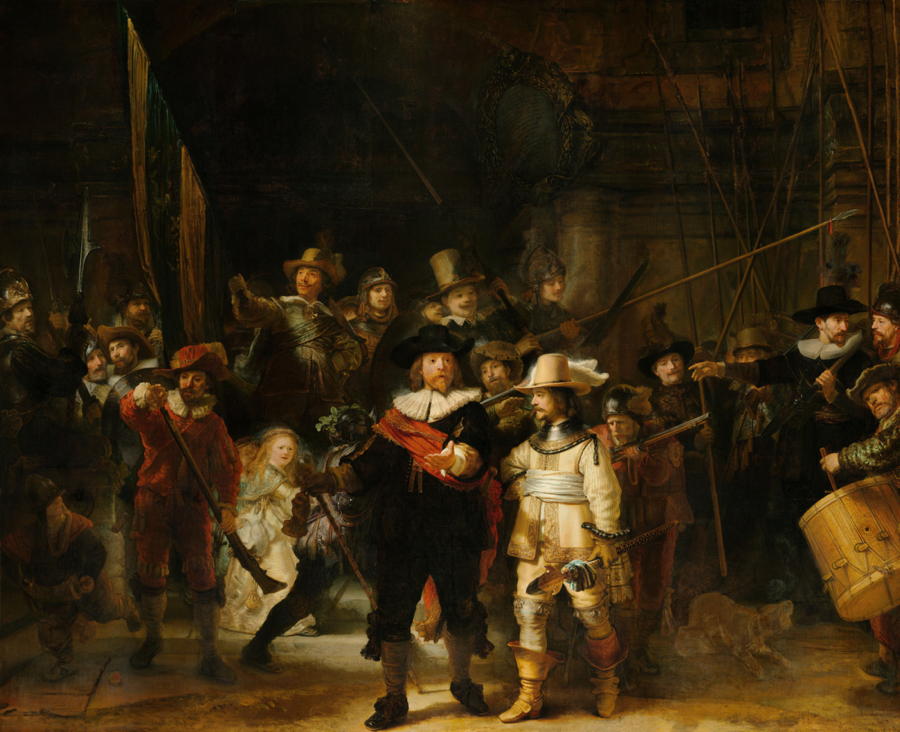
The Night Watch: by Rembrandt van Rijn, The Night Watch, 1642. Oil on canvast
A musket is being loaded. Another has just been fired. At the right, a drummer plays beside a barking dog, while two officers advance from the crowd. Rembrandt’s “The Night Watch” is a portrait you can almost hear and see move.Rembrandt van Rijn, The Night Watch, 1642. Oil on canvasAn Amsterdam militia company gathers beneath a dark archway. A captain is in black with a red sash who advances beside a lieutenant in yellow, while a brightly lit girl, an armed guardsmen, a drummer, and a dog fill the scene. (Source).
Completed in 1642, the painting began as a commission to portray an Amsterdam civic guard company under Captain Frans Banninck Cocq. These volunteer militia companies helped defend Dutch cities, and membership carried considerable social standing. The portrait gave the company a lasting presence in its meeting place, the Kloveniersdoelen, where it hung with other militia portraits. Its purpose was both collective and personal: to represent the company while preserving the likenesses of its members. (Source).
Rembrandt had received the commission before December 1640, although exactly how long he worked on the canvas remains unknown. The setting was ambitious: his picture belonged to an ensemble of seven large group portraits in the building’s great hall. Imagine entering a room where the city’s armed citizens looked down from the walls, each company presenting its own version of dignity and readiness. (Source).(Source).
Rembrandt made readiness look wonderfully untidy. At the center, the captain, dressed in black with a red sash, gestures while his lieutenant, Willem van Ruytenburch, stands beside him in luminous yellow. The Rijksmuseum reads the captain’s gesture as an instruction to set the company marching. Around them, weapons, faces, and bodies point in different directions. You keep discovering another person behind a shoulder or beneath a hat. The overlapping figures make the gathering feel larger than the space available to contain it. [Source](https://www.rijksmuseum.nl/en/collection/SK-C-5) · [Source](https://artsandculture.google.com/story/the-night-watch-rijksmuseum/FAXRivMco4xIJA)
Light supplies the order that the crowded scene seems to lack. It catches the captain’s hand, illuminates the lieutenant’s costume, and draws attention to a young girl behind them. Her presence becomes less puzzling when you notice the chicken hanging at her waist. The Rijksmuseum interprets her as the company’s mascot: the bird’s prominent claws and a nearby pistol refer to the Kloveniers’ symbols. This is the museum’s symbolic reading of the figure, rather than a documented explanation in Rembrandt’s own words. [Source](https://artsandculture.google.com/story/the-night-watch-rijksmuseum/FAXRivMco4xIJA)
Even the familiar title arrived long after the paint dried. The Rijksmuseum identifies 1797 as the first documented use of *Night Watch*. Despite the deep shadows, the museum describes the scene as a daylight march. The nickname encourages us to imagine a nocturnal patrol, but the action is a company assembling to move out. Once you know that, the painting’s bursts of brightness feel less like isolated lights in darkness and more like a crowd emerging into the day. [Source](https://www.rijksmuseum.nl/en/story/10-things-about-rembrandt-s-night-watch) · [Source](https://www.rijksmuseum.nl/nl/story/why-is-the-night-watch-so-famous)
The painting’s later history includes an alteration that is startling to contemplate. On May 23, 1715, an order directed that it be cleaned and transferred to Amsterdam’s town hall. The exact date of the move is uncertain; the Rijksmuseum places it in or shortly after 1715. To fit between two doors in its new location, the canvas was cut down. A later account lamented the loss of whole figures on the left and part of the drummer on the right. [Source](https://www.rijksmuseum.nl/nl/story/the-missing-pieces-of-the-night-watch-article)
An early, much smaller copy, attributed by the Rijksmuseum to Gerrit Lundens, preserves evidence of the wider composition. The National Gallery, which owns that copy, points out two men and a child at the far left who no longer appear in Rembrandt’s surviving canvas. A modest copy thus became an essential witness to the appearance of a masterpiece. [Source](https://www.rijksmuseum.nl/en/collection/object/Copy-of-The-Night-Watch–262d52558e31de3e998f1d79cadc035f) · [Source](https://www.nationalgallery.org.uk/paintings/gerrit-lundens-after-rembrandt-the-company-of-captain-banning-cocq-the-nightwatch)
What makes *The Night Watch* matter is visible even before we learn any of this history. Rembrandt turns the practical business of identifying a group into the experience of encountering one. Rank is clear, yet individual movements interrupt the order; the eye follows a command, then wanders toward a face, a weapon, or that improbable chicken. Spend a few minutes with the reproduction and watch where your attention goes. The company has been preparing to march for nearly four centuries, and it still seems capable of stepping forward.
Comments
The Night Watch: Rembrandt’s Active Group Portrait — No Comments
HTML tags allowed in your comment: <a href="" title=""> <abbr title=""> <acronym title=""> <b> <blockquote cite=""> <cite> <code> <del datetime=""> <em> <i> <q cite=""> <s> <strike> <strong>