Making Comics: Storytelling Secrets of Comics, Manga and Graphic Novels
Making Comics: Storytelling Secrets of Comics, Manga and Graphic Novels

- ISBN13: 9780060780944
- Condition: New
- Notes: BRAND NEW FROM PUBLISHER! BUY WITH CONFIDENCE, Over one million books sold! 98% Positive feedback. Compare our books, prices and service to the competition. 100% Satisfaction Guaranteed
Scott McCloud tore down the wall between high and low culture in 1993 with Understanding Comics, a massive comic book about comics, linking the medium to such diverse fields as media theory, movie criticism, and web design. In Reinventing Comics, McCloud took this to the next level, charting twelve different revolutions in how comics are generated, read, and perceived today. Now, in Making Comics, McCloud focuses his analysis on the art form itself, exploring the creation of comics, from the bro

List Price: $ 22.99
Price: $ 12.44
Red: The Heroic Rescue (The Circle Trilogy Graphic Novels, Book 2)
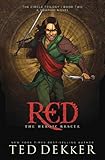
The stakes of the mind-bending story spun in Black are raised to a new level in Red. In one world, Thomas Hunter must lead a small, highly trained force of 30,000 against an unstoppable army of a million warriors. In the other he will face an evil beyond the scope of imagination. Product Details
* Paperback: 132 pages * Publisher: Thomas Nelson (October 9, 2007)
* ISBN-10: 0979590019 * ASIN: B0023RSZX2
* Product Dimensions: 10 x 6.6 x 0.3 inches * Shipping Weight: 7.2 ounces
List Price: $ 9.99
Price: $ 3.39
[phpbay]graphic novel, 4, “”, “”[/phpbay]
Making Comics: Storytelling Secrets of Comics, Manga and Graphic Novels related articles from the blogosphere…
Making Comics and Cartoons | spanishplans
But to really make it look professional, let’s use some technology! For those with limited internet access, our first suggestion is to use Microsoft Powerpoint to create a comic. Use Microsoft’s auto ‘shapes’ that look like speech …
Publish Date: 02/09/2011 19:16
http://spanishplans.wordpress.com/2011/02/09/making-comics-and-cartoons/
Making Comics: Why I've Failed So Far
If you’ve been around iFanboy for a long time, you’ve probably heard me talking about breaking in to comics, or making comics. It’s no secret that I fancy myself a writer, and that I have the stuff to get some comics published. …
Publish Date: 02/02/2011 7:00
http://www.ifanboy.com/content/articles/Making_Comics__Why_I_ve_Failed_So_Far
Free Technology for Teachers: 10 Ways to Create Comics Online
Creating cartoons and comic strips can be a good way to get reluctant writers writing. While creating comics you and your students can work through the elements of fiction in a context that is fun and familiar to them. …
Publish Date: 12/10/2010 4:00
http://www.freetech4teachers.com/2010/12/10-ways-to-create-comics-online.html
Making Comics with Doug Tennapel
Doug Tennapel discusses comics, storytelling, and his new book Power Up.
Possibly related posts:
- Related posts on comics
- The Harvey Comics Treasury Volume 2 « Newton Howatt
- » January's capsule comics reviews
- Related posts on Graphic
- The Graphic Arts Blue Book Returns – Exclusively Online | Self …
Great for learning the craft of comics (and for classroom use),
“Making Comics” is true to its title — it’s very well suited for folks eager to learn the craft of “making comics.” I teach a Sequential Art class at California State University, Fullerton and I have made it a required reading book, because it so solidly articulates the elements of comic art from the perspective of the artist. McCloud has been teaching comics at workshops and guest speaking engagements across the country. His having been in the teacher’s seat manifestly helps make his points all the more applicable and meaningful. For instance, McCloud uses examples from comics from around the world (Asian mangas, Eurocomics or BD, Western superheroes and alternative comics) that will resonate with modern audiences who perceive comics as more than the “mainstream” superhero comics. “Making Comics” casts the same clarity and passion that made “Understanding Comics” so compelling, and it is not as speculative as “Reinventing Comics.” Readers of “Understanding Comics” may find that “Making Comics” covers a lot of the same ground, and that is inevitable (so if you are more into analyzing comics rather than making your own, “Understanding Comics” is for you). In a nutshell, Making Comics is a solid starting point for budding and eager comic artists!
Was this review helpful to you?

|The Great McCloud Comics Trilogy- 3 of the Best-Ever,
Want 3 of the best-ever books on the general topic of comics? Here they are! (each generally sold separately)
1.*Understanding Comics- A *landmark* & bestselling examination of the medium. A comicbook on comics! While I try not to use the “genius” label *too* liberally, with Understanding Comics it really seems to fit(!). 5 Stars!
2.*Reinventing Comics- Maybe his best *looking* book (in my opinion), it’s basically split into 2 sections: The 12 Revolutions in comics; and then basic Internet/Computer/Web Comics. It’s the least popular & practical in the Trilogy, yet I still really like it! 4-1/2 Stars.
3.*Making Comics- It’s like Understanding Comics refined, as well as a “hands-on” introduction to the medium. It’s the thickest book of the three, dealing with the most critical questions involved in the comics creating process. Since making comics basically means writing with pictures, McCloud begins with this. How many panels do we need? What should they contain? What’s the clearest way to communicate our ideas? He first helps us with these things, and then moves to our real center of interest: characters! How to create and illustrate interesting characters is a central theme throughout. Once we establish our pictures & characters, words can be added to complete our ideas. He explains various ways to do this, basically refining his ideas in Understanding Comics. Perspective is only barely touched upon here; most books similarly briefly mention it. He explains that it’s a difficult yet necessary part of the picturemaking process, and that it can actually be quite fun(!). He also touches on eastern/western differences in comics, explaining how & why Japanese methods are still gaining in influence. Common materials & equipment professionals use, as well as common philosophical approaches are included. It’s basically Understanding Comics made even more practical & clear- with many added hints, tips, and tricks along the way. It competes with that 1st title for most popular in the Trilogy, and it’s highly recommended to anyone who wants to make comics! ! I like it! 5 Stars.
In conclusion: The 1st is genius; the 2nd is fascinating; the 3rd is highly refined- get this great McCloud comics trilogy today!
Was this review helpful to you?

|For any fan of comics (even if you can’t draw),
When it comes to artwork, I am at the stick figure level. My talents for making visual art, whether painter, comic book artist or whatever, are, at best minimal. At first glance, therefore, it might seem that I am not the right audience for a book like Scott McCloud’s Making Comics. I am, however, a long-time comic book fan. The advantage to Making Comics for a drawing layman like myself is the same as watching a “making of” documentary of a movie (or listening to a DVD commentary). You gain a better understanding of what you are looking at.
Unlike a painting, comic strip writing is a sequential art, a depiction of a series of pictures that, typically with text, tell a story. McCloud gets into the narrative aspects of comics writing immediately with a chapter on writing with pictures in which he discusses how the sequence of pictures (or panels) typically relate to each other. For example, panels can go from moment-to-moment, depicting a single action as a series of moments (like showing a baseball player swinging a bat. A different panel transition is action-to-action, showing a subject doing a series of actions (panel one shows the player hitting the ball, two shows him running, three shows his sliding, etc.). Besides these choices of moment, there are also choices of frame (essentially, point of view), choice of image, choice of word and choice of flow.
McCloud also goes into how to draw people, how to blend word and picture, how to build worlds, and, in the only chapter that is really specific to actual artists, what the tools of the trade are. There is a lot in this book, and it’s all told with McCloud’s easy going narrative where a depiction of himself guides us through all the ideas.
Part of the magic of comics is the way the reader’s mind fills in the gaps, an idea that McCloud first introduced in Understanding Comics. With a couple dots and a line, we can see a face. When we see two panels, one showing a player swinging at a ball, the next with him making contact, we “see” the motion even if it’s not really there. Similarly, we feel like it is actually McCloud talking to us, even if it’s really just a picture of him (and making is nothing like what he really looks like).
In short, this is a brilliant book. I am not a huge fan of Reinventing Comics, but Understanding Comics is a classic and this book follows right in its footsteps. If you enjoy comic books (or comic strips), this book is a must-read, even if you can’t draw.
Was this review helpful to you?

|Great Adaptation, Superb Artwork,
It’s been fifteen years since Thomas Hunter, general of the Forest Guard, has dreamed. He eats the rambutan fruit every day to keep from dreaming, thus keeping him from traveling back to his world. He is now a leader of Elyon’s people, a husband, and a father. He leads the Forest Guard in an ongoing war against the Horde, a diseased and tormented people that refuse to follow Elyon. As the Horde army closes in on his people, Thomas must finally travel back to his world to gather information he needs to defeat the enemy.
Back in Thomas’ world time has practically stood still since he left. The deadly Raison Strain has been released into the population, and it’s only a matter of days before the world is infected. Thomas is the only one who can find the one person capable of creating an antidote. Every choice Thomas makes in one world effects the destiny of himself and his loved ones in the other. The fate of both worlds is in his hands.
Ted Dekker’s Circle Trilogy novels were groundbreaking to say the least when they were released in 2004. I still consider this trilogy to be one of the most inspirational and entertaining fictional works I’ve ever read. Naturally, I was thrilled when I heard the news that Circle Media was publishing the trilogy in graphic novel form. I must say the result is everything I was hoping for.
That being said, I would never suggest that someone should read the graphic novels instead of the novels to get the whole story. There is simply too much packed into these stories and you can only get the full experience through the actual books. But are the graphic novels worth reading? Absolutely!
Hats off to the writers who have cleverly adapted Dekker’s complex plot lines into a story that flows well in the graphic novel format. Readers who are unfamiliar with the story will have no trouble following the story threads flowing through the alternating realities. The artwork is superb on every level. Seeing this story brought to life in such vivid detail was such a thrill, and I especially loved the way the artists effectively portrayed the other reality.
This is indeed a fun way to experience or re-experience Ted Dekker’s most popular work. Circle Media has plans to adapt more of Dekker’s works into graphic novels, with Showdown next on the list. If nothing else I hope these graphic novel adaptations will introduce more readers to Dekker and his arsenal of quality storytelling.
Was this review helpful to you?

|Great stuff,
This was definitely my favorite of the books in the Trilogy, and this is a great way to experience it again. Great for people getting introduced to Ted, and great for long-time fans to experience Ted’s best work again.
Was this review helpful to you?

|Great great great!,
Product in GREAT condition (as posted). VERY speedy delivery! No damaged pages. Looks as if it hadn’t been read or opened ever before.
Was this review helpful to you?

|