Hokusai: Painting Up a Storm
Hokusai: Still Painting Up a Storm
Here is Katsushika Hokusai’s Thunder god, 1847, Edo period. A hanging scroll of ink and color on paper.
Katsushika Hokusai was in his eighties when he painted this red-skinned thunder god. Drumsticks raised, the deity hovers inside a rolling mass of clouds, with ribbons twisting around his body. The painting is bursting with the energy of a storm thundering overhead. Source
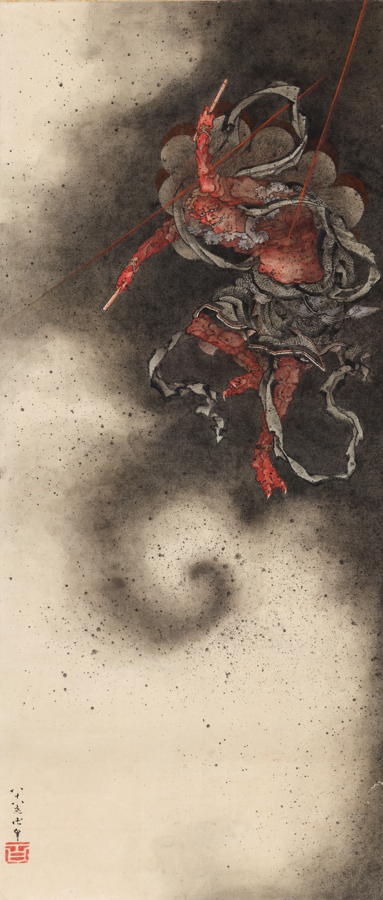
Hokusai God of Thunder – A red-skinned thunder god holds two drumsticks amid swirling, ink-splattered black clouds. A ring of drums rises behind him, and flowing ribbons curl around his body in a tall, narrow composition.
His “Hokusai manga”, first published in 1814, offered pages crowded with drawings of people, creatures, and everyday activities. Then came the landscape series “Thirty-six Views of Mount Fuji”, including “The Great Wave”, dated by the Metropolitan Museum of Art to about 1830–32. In that celebrated print, a mountain becomes a small, distant triangle beneath an immense curling wave. Hokusai could make scale itself part of the story. Source· Source.
One episode shows that his interest in scale was thoroughly practical. In 1817, Hokusai staged a public painting demonstration at a temple in Nagoya. His subject was Daruma, the Buddhist figure also known as Bodhidharma. His paper measured roughly 18 meters by 11 meters – about 59 by 36 feet. On that enormous surface, he painted a half-length figure using a giant brush. Source.
This is an unusually well-supported artist anecdote. Nagoya City Museum holds a promotional handbill for the event and an illustrated account by Kōriki Enkōan, whose record supplies details of the performance. The spectacle is easy to imagine, but we do not need to invent the audience’s astonished conversations: the surviving documents are impressive enough. Here was an artist prepared to turn the act of painting into a public attraction. The confidence and the talent of this artist is a delight to contemplate. Source.
Hokusai’s working life also involved continual reinvention. He adopted different artistic names, among them one meaning “Old Man Crazy to Paint.” The changing signatures marked artistic ambitions and spiritual commitments. And his achievement depended on relationships: publishers, block cutters, and printers helped bring his designs to readers, while his daughter, the painter Ōi, worked closely with him in his later years. Source.
In “Thunder god”, which rests in the Smithsonian National Museum of Asian Art was completed two years before his death in 1849, that restless energy remains visible. The Smithsonian identifies the deity as the god who beats his drums during storms. Look at the scattered ink surrounding him: it gives the clouds a turbulent, almost gritty texture. Farther down the scroll, pale areas open between the dark masses. To my eye, that long stretch of unsettled air makes the figure’s arrival feel sudden and explosive. Source.
Hokusai’s own writing suggests how unfinished he considered his education. In the postscript to “One Hundred Views of Mount Fuji”, he imagined reaching greater artistic understanding at one hundred and making every mark come alive at one hundred and ten. These were his declared hopes, though he did not achieve such an age. Did he actually believe he would? We do not know. He died in 1849, still producing remarkable paintings. Looking at this airborne drummer, it is easy to appreciate the ambition: he wanted the picture to feel alive, and there is scarcely a quiet inch of it. Source
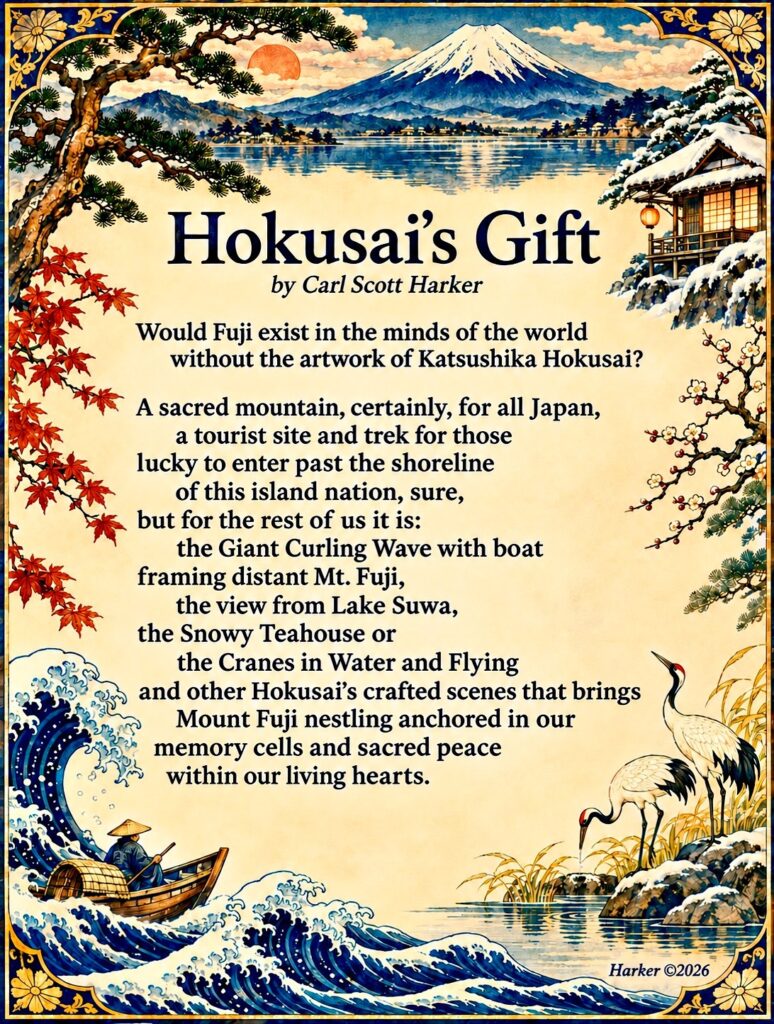
Hokusai’s Gift by Carl Scott Harker • Poster Available on eBay, Click Here.
Comments
Hokusai: Painting Up a Storm — No Comments
HTML tags allowed in your comment: <a href="" title=""> <abbr title=""> <acronym title=""> <b> <blockquote cite=""> <cite> <code> <del datetime=""> <em> <i> <q cite=""> <s> <strike> <strong>